
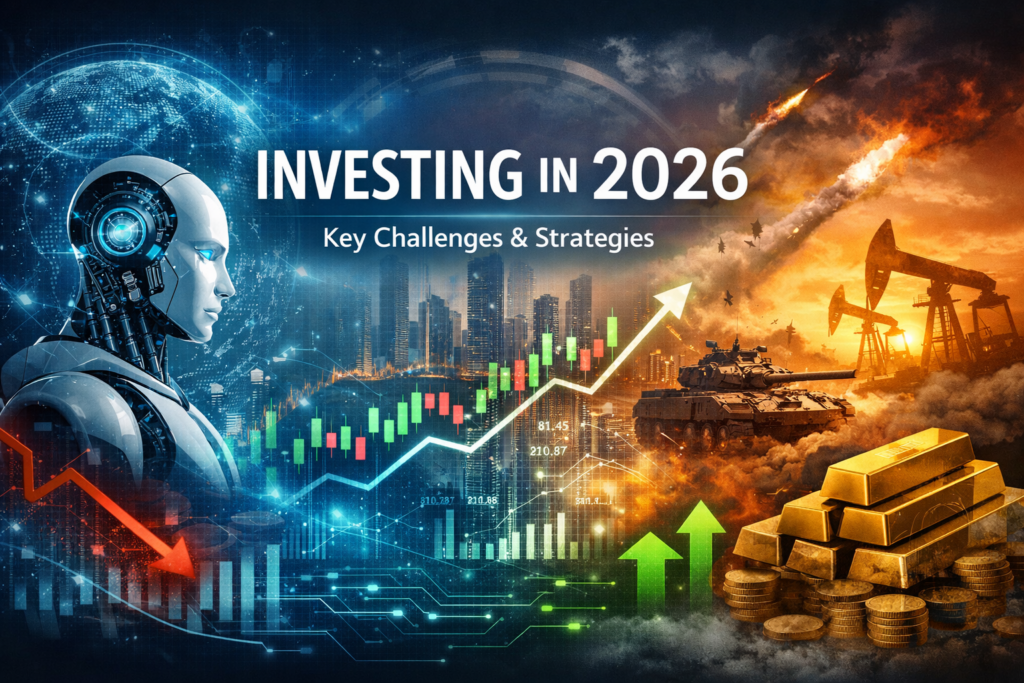
The investment landscape in 2026 is shaped by rapid technological progress, geopolitical uncertainty, and structural shifts in the global economy. Traditional strategies alone are no longer sufficient. Investors must adapt to new risks while identifying emerging opportunities.
In this article, we explore the biggest investment challenges in 2026 and outline how you should invest to stay resilient and future-ready.
1. The Major Investment Challenges in 2026
Persistent Market Volatility
Financial markets in 2026 remain highly sensitive to:
- Geopolitical tensions
- Monetary policy adjustments
- Rapid information flow driven by AI and social media
Volatility is no longer an exception—it is the norm. Sudden market swings can occur within minutes, making emotional decision-making a serious risk for investors.
Artificial Intelligence Disrupting Entire Industries
AI is no longer just a productivity tool; it is reshaping entire sectors such as finance, healthcare, logistics, and manufacturing.
- Companies that fail to adopt AI lose competitiveness
- Valuations increasingly depend on data, automation, and scalability
- Traditional business models face accelerated disruption
Investors must distinguish between real AI-driven value creation and short-term hype.
Higher-for-Longer Interest Rates
Unlike the ultra-low-rate environment of the past decade, 2026 continues to be characterized by relatively elevated interest rates:
- Growth stocks face higher valuation pressure
- Debt-heavy companies struggle with refinancing
- Fixed-income investments regain relevance
Capital efficiency and balance-sheet strength are more important than ever.
Inflation and Purchasing Power Risks
Although inflation may be lower than its peak years, it remains structurally higher than in the 2010s. This creates long-term risks for:
- Cash-heavy portfolios
- Fixed-income assets without inflation protection
Preserving real purchasing power becomes a central investment goal.
2. How Should You Invest in 2026?
Focus on Quality and Resilience
In uncertain environments, quality beats speculation. Look for companies with:
- Strong cash flows
- Pricing power
- Low debt levels
- Sustainable competitive advantages
These businesses are better positioned to navigate economic slowdowns and market shocks.
Diversification Across Asset Classes
Relying solely on equities is increasingly risky. A robust 2026 portfolio should consider:
- Global equities (not just one region)
- Bonds and money-market instruments
- Commodities and real assets
- Select alternative investments
Diversification reduces dependency on a single macro scenario.
Use AI as a Tool, Not a Blind Strategy
AI-powered investment tools can enhance decision-making by:
- Analyzing large data sets
- Identifying trends and risks early
- Supporting portfolio optimization
However, AI should support, not replace, strategic thinking. Human oversight remains critical—especially during extreme market events.
Think Long-Term, Act Adaptively
Short-term market timing becomes increasingly difficult in 2026. Instead:
- Maintain a long-term investment horizon
- Rebalance portfolios regularly
- Adjust exposure as macro conditions evolve
Flexibility is a competitive advantage.
3. Key Investment Themes for 2026
- Artificial Intelligence & Automation
- Energy transition and infrastructure
- Cybersecurity and digital resilience
- Healthcare innovation and longevity
- Defense and strategic resources
These themes reflect structural trends rather than short-lived cycles.
Conclusion: Investing in 2026 Requires Strategy, Not Prediction
The biggest challenge in 2026 is not uncertainty itself—but how investors respond to it. Markets reward those who combine discipline, diversification, and adaptability.
By focusing on quality assets, leveraging AI responsibly, and maintaining a long-term perspective, investors can navigate 2026 with confidence and position themselves for sustainable growth beyond it.
Schreibe einen Kommentar